

Last Updated: November 14, 2026
Quick Summary
Printable trivia is a good fit for family gatherings because it needs almost no setup, keeps phones out of the room, and lets people of different ages compete together. Printing a sheet with an answer key lets the host run a fair game quickly. Mixing easy, medium and challenging questions helps every age group join in.
- Printable sheets can be downloaded, printed and started within minutes.
- Print one copy per team plus a separate answer key kept with the host.
- A mix of about 40% easy, 40% medium and 20% challenging questions suits mixed-age tables.
- Run three rounds of about ten questions each for a game that fits inside an hour.
- Prepare tie-breaker questions in advance and decide how they will be settled before play.
Table of Contents
- Why Printable Trivia Works for Family Gatherings
- Printable Trivia for Family Gatherings With Answers
- Printable Trivia for Family Gatherings Multiple Choice Options
- Easy Printable Trivia for Family Gatherings Across All Ages
- Family Reunion Trivia Questions by Category
- Hosting Tips: Setup, Scoring and Print Details
- Which Printable Trivia Set Should You Download Next?
- Frequently Asked Questions
Why Printable Trivia Works for Family Gatherings
Printable trivia gives a family gathering a ready-made game with almost no setup. Printable trivia sheets can be downloaded, printed and started within minutes, which is a big reason they suit busy hosts. There is no phone to pass around and no screen pulling anyone away from the table.
Printable trivia also levels the field. A grandparent, a teenager and a seven-year-old can all sit at the same table and answer questions they know. Hosts often find that the quieter relatives speak up once a question lands in their area of knowledge.
The format works for a few practical reasons: it is affordable, it is quick to run and it keeps people talking. Each sheet is a short burst of competition, so the game moves along without anyone having to sit through a long turn.
Printable Trivia for Family Gatherings With Answers
An answer key is the feature that makes printable trivia easy to host. Without one, the host has to check every response from memory, and arguments follow. With a key on hand, the host reads each question, collects the answers and moves on.
Many families print two copies of each sheet: one for playing, and one marked with the answers for the host. The host keeps the answer sheet face down until scoring time. This simple habit keeps the game fair and stops anyone from peeking.
If you print a sheet without its key, write the answers in pencil on a spare copy. Keep that copy somewhere the kids will not find it.
Printable Trivia for Family Gatherings Multiple Choice Options
Multiple choice works well when the group includes younger players. Four options per question give a child a real chance to guess right, and an adult still has to think. Printable sets that include multiple choice let you mix difficulty without splitting the room into two games.
Multiple choice also speeds up the game. Players can answer on a sheet of paper in seconds, which keeps the energy up during long gatherings. Open-ended questions work better for small groups of adults who enjoy debate.
Pick the format that matches your group. A mixed-age table usually benefits from a combination of both styles.
Easy Printable Trivia for Family Gatherings Across All Ages
The hardest part of family trivia is not the questions; it is the age spread. A seven-year-old, a teenager, and a grandparent rarely know the same facts. A useful approach is to choose a printable set that mixes easy, medium and challenging questions, labelled by difficulty, so one table can play together without splitting into separate games.
Build the kit in three tiers.
- Easy (ages 6-10 and anyone who wants a warm-up): animals, colours, simple food, basic geography, and familiar storybook or movie characters. These questions should be answerable by most of the table.
- Medium (teens and adults): general knowledge, science basics, holidays, and pop culture from the last decade or two.
- Challenging (adults and confident teens): history, older pop culture, and family-history questions written by the host.
A practical mix for a mixed-age table is roughly 40% easy, 40% medium, and 20% challenging. That ratio lets younger players contribute early and keeps older players engaged in the final round.
Sample question types by tier. Easy items work best as multiple choice with four options, because a child can reason toward an answer. Medium items can be a mix of multiple choice and short answer. Challenging items work well as open-ended questions, with the host accepting close answers. Label each question with a small difficulty tag (E, M, C) on the sheet so teams know what they are attempting.
A play format that keeps ages together. Pair each child with an adult or teen to form mixed teams. Play three rounds: easy, medium, then challenging. In the easy round, only the youngest player on each team may answer, with teammates allowed to whisper hints. In the medium round, anyone can answer. In the challenging round, the team must agree on one answer before writing it down. This structure gives every age band a round where they lead, and it turns the game into coaching rather than competition between age groups.
Adapt for different gathering sizes. For a small group of four to six, play individually and use the difficulty tags to let each player choose a tier per question. For a large reunion, run teams of four to six at separate tables with the same sheet, then compare scores at the end. For remote relatives, share the PDF by email or screen share and have each household play as a team on a video call. For a single player, use the sheet as a solo quiz and track a personal best.
Keep it fair and kind. Avoid questions that depend on a specific family's private history unless the host writes them and every team has a fair chance. Skip sensitive topics such as politics, religion, and recent losses. If a question lands badly, the host should move on quickly rather than let it derail the round.
Watch out: if you hand the same sheet to every team without difficulty tags, younger players may feel shut out by the challenging questions. Print the tags, or read questions aloud and let each team choose its tier before answering.
A mixed-age table works best when the youngest and oldest players both have a round to shine. Build the kit around that goal, and the game stops feeling like a test and starts feeling like a family activity.
Suggested mix of question difficulty for a mixed-age table
Family Reunion Trivia Questions by Category
Categories keep a long game organised. A reunion can run through family history, general knowledge, science, holidays and pop culture, with one round per category. Printable trivia sheets that already sort questions this way save the host from sorting them by hand.
Family history rounds are often the highlight of a reunion. Questions about shared memories, old photographs and family stories let the eldest relatives shine. Write a few of these yourself before the event, since only your family knows the answers. Fill-in-your-own sheets make this easy.
Science and general knowledge rounds suit the teenagers and adults. Holiday rounds work well for winter gatherings, and pop culture rounds bring in the younger relatives. Mixing categories keeps the game from feeling like a school test.
Hosting Tips: Setup, Scoring and Print Details
A printable trivia game runs on three decisions you make before guests arrive: how many rounds, how points work, and how you will break a tie. Settle those first, and the rest of the gathering takes care of itself.
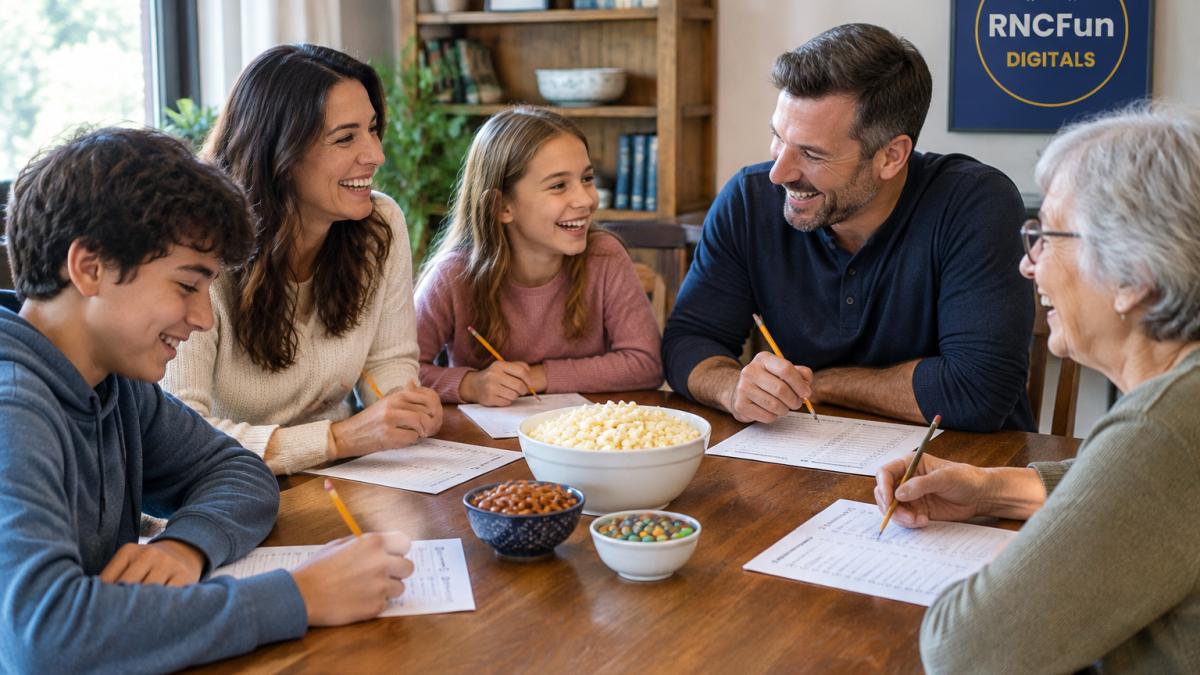
Round structure. A common pattern for a mixed-age gathering is three rounds of ten questions each. Round one is easy warm-up, round two is medium with mixed categories, and round three is the challenge round. Ten questions per round keeps each round to roughly 10-15 minutes at a relaxed pace, so a full game fits inside an hour without anyone losing focus. If your group is large or easily distracted, use two rounds of eight questions instead and add a lightning round of five quick true-or-false items at the end.
Scoring. The simplest system that survives a family table is one point per correct answer, with a bonus point awarded when every member of a team answers correctly on the same question. Announce the system before question one. For multiple-choice sheets, score one point per correct letter; for open-ended sheets, accept close-enough answers and let the host make the final call. A running tally on a whiteboard or a shared sheet avoids disputes later.
Timing. Give teams a fixed window per question rather than an open-ended pause. Two minutes works for open-ended questions; thirty to forty-five seconds is enough for multiple choice. Use a phone timer or a kitchen timer and call time clearly. For the final round, shorten the window slightly to keep energy up.
Tie-breakers. Prepare two or three tie-breaker questions in advance and keep them separate from the main sheet. A good tie-breaker is a single hard question with a numeric or dated answer, so the closest guess wins if nobody is exact. Decide in advance whether a tie-breaker is sudden-death (first correct answer wins) or closest-guess, and state it before you need it.
Print details. Print one copy per team plus one spare, and print the answer key separately so it never sits on the playing table. Check that pages line up and that the answer key is on its own sheet. Set your printer to fit the page rather than scale it, and choose black-and-white or ink-saver mode for large groups. Standard printer paper is fine for a single game, and a slightly thicker stock can better survive repeat play and handling by younger children.
Accessibility and no-printer options. Offer a large-print version with high-contrast text for older relatives, and read questions aloud so anyone with low vision can still play. If you cannot print, open the PDF on a tablet or laptop and display one question at a time, or read from the screen while teams write answers on blank paper. A screen-reader-friendly PDF should have selectable text rather than scanned images; check this by trying to highlight a question before the event.
Practical checklist.
- Print one copy per team plus a spare, and a separate answer key.
- Set the printer to fit the page, not scale it.
- Choose colour for a polished look or black-and-white to save ink.
- Bring spare pencils and a timer.
- Keep the answer key face down until scoring.
- Have tie-breaker questions ready before the first round.
Watch out: if you print the answer key on the back of the question sheet, a curious player can flip it over mid-round. Print the key on its own page and keep it with the host.
A bowl of snacks and a comfortable table help more than people expect. Families tend to stay longer when the game feels relaxed.
!A family of mixed ages gathered around a dining table with printed trivia sheets, pencils and a bowl of snacks, laughing during a game night
Which Printable Trivia Set Should You Download Next?
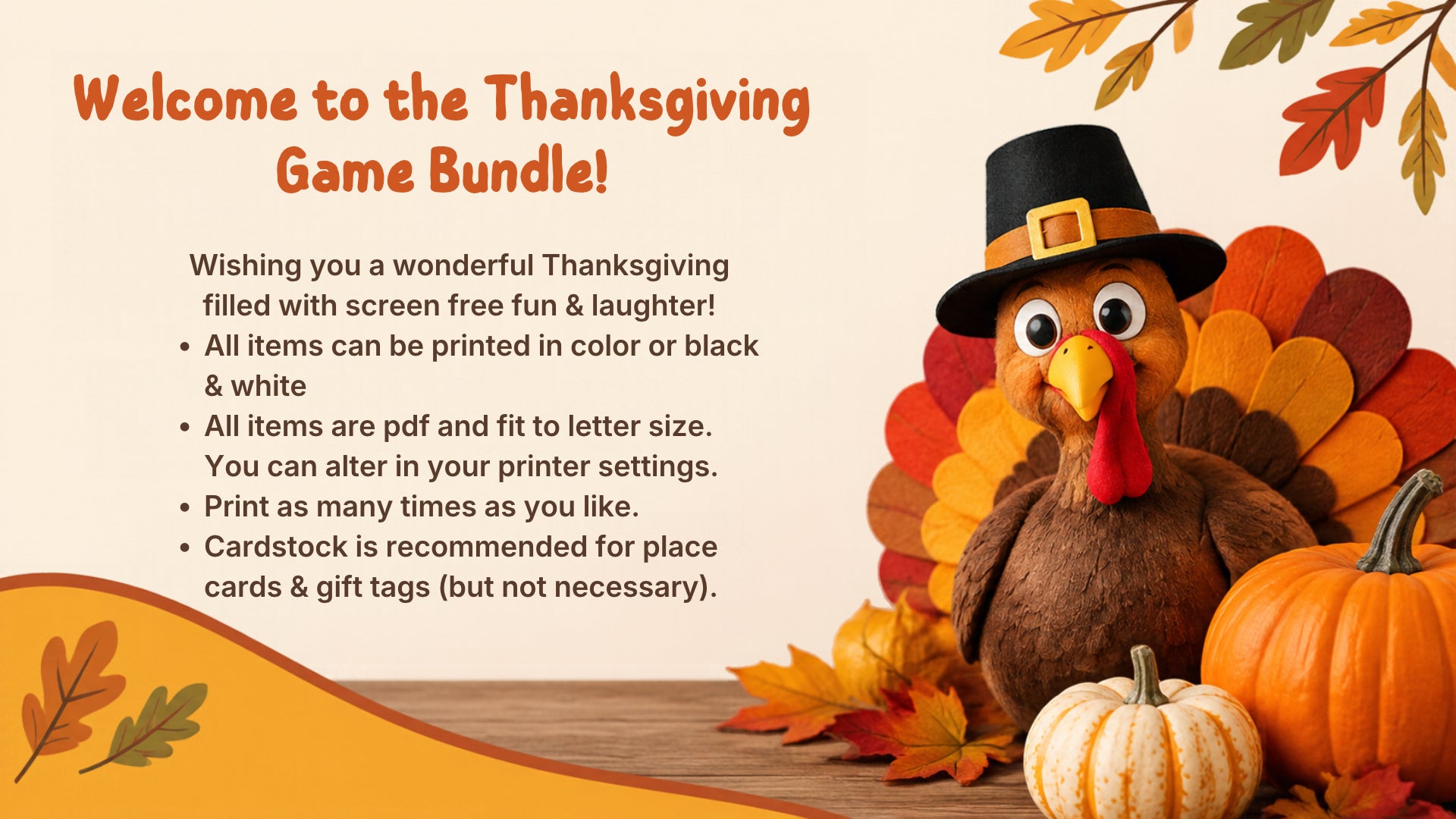
If your gathering is around Thanksgiving, the Thanksgiving printables: bingo, trivia, charades & more for kids & adults. bundle gives you trivia for both kids and adults alongside other games. It is a good pick when you want a full set of activities for one evening.
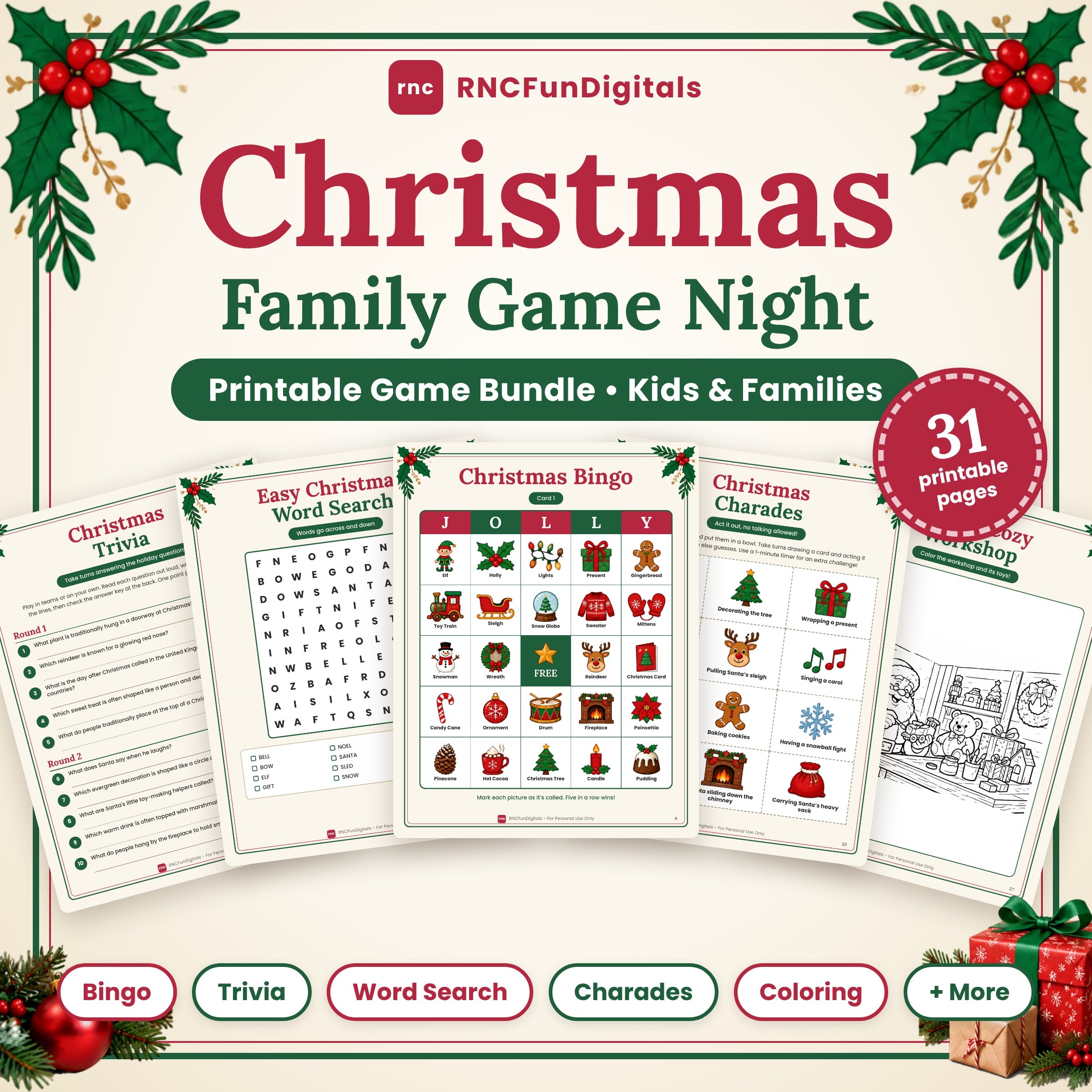
For a winter party, the Christmas Family Game Night Bundle 🎄 includes Christmas trivia, word searches, charades and drawing challenges. It suits mixed-age groups that want more than trivia alone.
Want more printable game ideas before you choose? Read Printable Games for Family Game Night You Can Print Tonight for setup advice and more print-ready options.
For younger children at the same gathering, Printable Christmas Activities for Kids: Free and Fun covers simple printable activities that keep the little ones busy between rounds.
Choose the set that matches your group's ages and your holiday, print a copy for each team, and start your first round tonight.
Get your family game night started with RNCFunDigitals printable trivia, ready to print and play. Keep the screens off the table and the laughter going.
Frequently Asked Questions
Where can I find free printable trivia games?
Many family blogs and craft sites offer free printable trivia sheets, though free sets often have fewer questions and no answer keys. RNCFunDigitals sells downloadable trivia as part of its game bundles, such as the Thanksgiving printables bundle, which has 30 pages of bingo, trivia and charades. Look for a bundle that includes an answer key and print-ready pages, which saves you time before a gathering. Compare the page count and answer key details before you download anything.
How many questions should a family trivia game have?
A good starting point is 20 to 30 questions for a single gathering, split into rounds of five or six. That is enough to keep everyone involved without dragging on past an hour. The Christmas Family Game Night Bundle includes 20 trivia questions alongside bingo, charades and word searches, so you can rotate activities if the group loses steam. Larger family reunions can handle more questions if you run teams.
How do you play family trivia with mixed ages?
Mix the difficulty within each round rather than separating kids from adults. Pair younger players with an adult or older teen, and let them share answers. Easy questions open each round, harder ones close it. Multiple choice formats help younger children join in because they can recognize the correct answer even when they cannot recall it. Keep the answer key handy so the host can settle disputes quickly.
What topics work well for family gathering trivia?
General knowledge, pop culture, science and holiday-themed questions cover most mixed-age groups. Family-specific questions about shared memories work especially well at reunions, and you can write your own to fill gaps in a printable set. Holiday bundles from RNCFunDigitals, including the Thanksgiving and Christmas sets, group trivia by occasion so you can match the theme to the gathering.
